
Bialetti Moka Express Review: Stovetop Coffee With a Real Kick
Disclosure: This post contains affiliate links. If you buy through them, we may earn a commission at no extra cost to you.
How we reviewed this: this article is based on research, manufacturer specs, and published owner and expert reports. We did not test the product hands-on.
Open a kitchen in Italy and there is a good chance you will find a Bialetti Moka Express on the stove. The octagon shape has barely changed in almost a century, and the reason is simple: it works. Based on manufacturer information and owner reports, here is how the six-cup model brews, what it does well, and where it asks for care.
Next we cover the parts, the brew steps, the taste, cleaning, and who should buy one.
The Parts
The moka pot is three metal pieces and a rubber gasket. The bottom chamber holds water. A funnel-shaped basket sits inside it and holds ground coffee. The top chamber screws on and collects the brewed coffee through a central tube. A safety valve on the bottom keeps pressure from building up too far.

The Moka Express comes apart into a base, a filter funnel, and a top chamber with the spout and handle. Image: Jcmontero via Wikimedia Commons, CC BY-SA 4.0 (creativecommons.org/licenses/by-sa/4.0/)
The simple design means there is little to go wrong. The gasket and the filter plate are the two parts that wear, and both are sold as spares. A well kept moka pot can last for decades.
How to Brew
Fill the bottom chamber with hot water up to just below the safety valve. Fill the basket with medium-fine coffee, level but not packed. Screw the top on tightly and place the pot on medium-low heat with the lid open. In a few minutes the coffee starts to flow into the top chamber. When it turns pale and starts to gurgle, take the pot off the heat and run the base under cool water to stop the brewing.
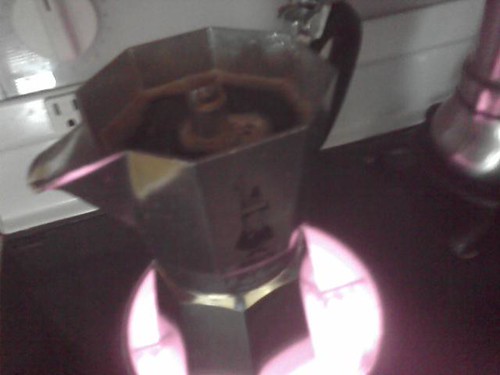
On the burner, the pot brews from the bottom up, so keep the heat low and the lid open. Image: Enkerli via Flickr, CC BY-SA 2.0 (creativecommons.org/licenses/by-sa/2.0/)
Using hot water in the base speeds things up and keeps the coffee from cooking in the metal. Cold water also works, but the grounds sit over a hot base for longer and can taste burnt. Heat that is too high is the most common mistake, and it gives a bitter, harsh cup.
How It Tastes
A moka pot makes coffee that is stronger than drip and lighter than true espresso. It has no crema, because a stovetop pot reaches much lower pressure than a pump machine. What you get is a thick, intense cup that stands up to milk. Many people make a latte or cappuccino by heating milk and pouring it over the moka coffee.

Left, ground coffee fills the basket. Right, the brew rises into the top chamber. Image: fakelvis via Flickr, CC BY-SA 2.0 (creativecommons.org/licenses/by-sa/2.0/)
Grind size matters. Too fine and the water struggles to pass, so the pot can sputter and taste harsh. Too coarse and the cup is thin and sour. A grind a little finer than drip, similar to table salt, is a good starting point.
Cleaning and Care
Let the pot cool, then rinse each part with warm water. Do not use soap if you can avoid it, and never put an aluminum moka pot in the dishwasher, because the detergent dulls the metal and can leave a taste. Dry every part before you put it away so the gasket does not hold moisture. Replace the gasket once a year or when it hardens.
Limits
This classic model is aluminum, so it does not work on induction cooktops. Bialetti sells steel versions for that. The six-cup size makes about nine ounces, which is enough for two small cups. If you want more, buy the nine or twelve cup size. Because it brews all at once, you cannot make a single small cup without a smaller pot.
Moka Pot Versus Espresso Machine
People often ask whether a moka pot can replace an espresso machine. It cannot, but it comes close enough for many drinks. A pump machine pushes water through the coffee at about nine bars of pressure. A moka pot works at one to two bars. That difference is why you get a thick, strong cup but no true crema.
For a morning latte, the gap is small. Heat and froth some milk, pour in the moka coffee, and you have a drink that tastes rich and balanced. For a straight shot, the difference is easier to notice. The pot gives a bolder, rougher taste, which some people prefer.
The cost gap is large. A decent espresso machine and grinder can cost several hundred dollars. The moka pot costs a small fraction of that and needs only a stove. If you are curious about espresso-style drinks and do not want to spend much, it is a fair place to start.
Who Should Buy It
Get the Moka Express if you want a low-cost, durable, no-power coffee maker, and you like strong coffee. It also makes a great second brewer for camping or a backup. Skip it if you have an induction stove, or if you want true espresso or fully hands-off coffee.
Pros and Cons
Pros
- Strong, rich coffee with a real espresso-like punch
- Aluminum body heats fast and lasts for decades
- Very low cost and no electricity needed
- Works on a gas or electric stovetop
- Few parts, easy to repair with spare gaskets
Cons
- Not true espresso, with no crema from a pump
- Takes a few tries to avoid a bitter or burnt cup
- Aluminum should not go in the dishwasher
- Not for induction cooktops unless you buy that version
Verdict
The Bialetti Moka Express is a small, honest coffee maker. It is cheap, tough, and good at making strong coffee for a latte or an after-dinner cup. Learn the heat and grind once, and you will get a good result every morning. If you need a machine for induction or want true espresso with crema, look elsewhere.